Decan Walk: Aquarius decan 3
Aquarius, ruled by Saturn (classical) and Uranus (modern), meets up with the ever-changing Moon, ruler of the decan in the Chaldean system. The Sevens have a correspondence to Venus, through Netzach on the Tree of Life. The triplicity ruler is also Venus, another planet that like the Moon, has phases.

Magical image of the decan per 777: A small-headed man dressed like a woman, and with him an old man.
The following is excerpted from Scions of 777, Volume I, Six-and-thirty decans, for the Seven of Swords:
“This is an instance where the 777’s decan description deviates from the rest somewhat, with the image of “A small-headed man dressed like a woman, and with him an old man.” Various of the descriptions describe the man as angry, envious, or deceitful; the Picatrix has the man with a mutilated head, accompanied by an old woman.
The “small-headed” bit rather reminds me of a quote from Shakespeare’s Hamlet. “I could be bounded in a nutshell, and count myself a king of infinite space, were it not that I have bad dreams. Which dreams, indeed, are ambition; for the very substance of the ambitious is merely the shadow of a dream.” Hamlet’s frustration as he grapples with the human condition, and his vacillation, resonate here.
The idea of being “small-headed” may also reflect the need to think outside the box and use your wits, to overcome a limitation or weakness. Or to outsmart someone who is trying to undermine you. It can represent needing to use your head to get out of a jam, and perhaps not always feeling up to the task or making appropriate effort. He is “dressed like a woman,” for both Venus and the Moon influence the card. The old man is of course for Saturn, ruler of Aquarius.
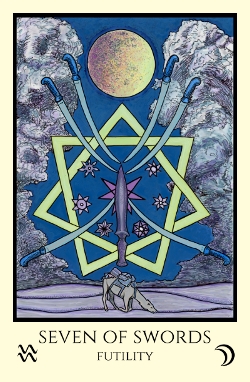
This small-headed man travels with an old man, under the influence of a waning moon, as six sabers threaten them. The cross-dressing man carries the seventh sword, but is hardly dressed for fighting in his long gown and wrap. The old man probably will not be much help either, bent and leaning on his cane. Yet he may be able to lend wisdom on this journey.
The figures taken alone are also purposefully ambiguous. The small-headed one is behind the old man with a sword. Is he ready to stand with him against the encroaching six dueling swords, or will he double-cross him?
The combination of a man dressed as a woman and an old man also reminds me of Achilles. In some accounts, his mother Thetis dressed him as a girl to hide him and keep him safe from war. But wily Odysseus (perhaps the old man figure) disguised himself as a peddler of women’s clothes and tricked Achilles into revealing himself. These themes of Achilles, by being in disguise, and Odysseus, being crafty and somewhat deceptive, fit with the reputation of the card for sometimes representing conniving. For while the Greeks admired Odysseus’ cunning and cleverness, the Romans considered his deceits as dishonorable.
Aquarius has a body correspondence to the ankles. Achilles is also known for his one spot of vulnerability, where the term “Achilles’ heel” originates. Thetis had dunked him in the Styx when he was an infant, to make him invulnerable to weapons, but had to hold him by the heel (or really, the tendon on the ankle near the heel). So, she missed a spot in the dunking, which was his undoing. This contributes to the idea of some weakness in play: futility or unstable effort.
The changeability of the moon as decan ruler adds instability here, along with the incompatible combination of Venus and Saturn. Aloof and cool Saturn-ruled Aquarius is not exactly the best place for warm Venus or the emotional Moon. In the sky, a seven-pointed figure combines the emblems of a star (Aquarius) and a rose (Venus), and contains a sliver of the moon. It picks up seven points along a ring of 56 “holes”, like the Aubrey holes at the monument of Stonehenge that mark out the lunar cycles, for the changes of the Moon influencing the decan.
Seven-pointed stars are also known as Faery Stars, associated with the notoriously tricky Fae. Where a pentagram is associated with the earthly magic of the elements, the seven-pointed septagram star is more celestial. The pentagram represents the four elements plus spirit, or the four directions plus the above. The seven-pointed star expands that to include the points below and within, places normally hidden from view. One should be careful when dealing with the hidden realms, as they are the “between” places of the Fae, who are known for tricking mortals.” (end of excerpt)

The Seven of Swords and the Aquarius decan 3 are both associated with deceit, betrayal, thievery, envy, and the detection of it, as seen in the Raphael image and significations:
| Raphael image and significations | A man having an envious look, holding his hand on his sides. Detection and affronts. |
The deity per the “36 Airs of the Zodiac” fragmentary text is Osiris, who was cruelly betrayed and dismembered by his bother Set – and cleverly re-assembled by his sister(s) and sister-spouse, Isis and Nephthys. The only part missing was the phallus, so in a sense, he was like a woman, like the man of the decan description.
The Ptolemaic god is Proteus, the shape-shifting and wily “Old Man of the Sea” – more of an Odysseus figure like the old man in the image.
Hello. I just finished going through most of the Scions of 777 book and cards for the first time. The work and expertise that went into these creations is quite impressive. An invitation to sensory overload, in fact. I am a mere dabbler, but I do appreciate the effort and thoroughness that went into these works. Some things are finally becoming clear to me. Thanks very much.
Thanks for taking the time to comment!