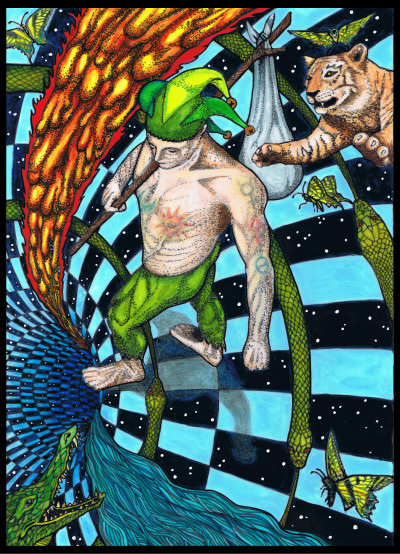
Decan Walk: first decan of Capricorn, Two of Disks

Happy Solstice, where the Sun enters the first decan of Capricorn. The first decan of Capricorn corresponds to the Two of Disks, known as Harmonious Change. It begins at the Solstice, the Winter solstice here in the Northern hemisphere, a cardinal sign hinge point where the longest night yields to the days beginning to lengthen again, albeit ever so slowly. a harmonious change.
Where the last decan, Sagittarius 3, was a Jupiter-ruled sign and Saturn ruling the decan, here we have the opposite in Capricorn decan 1: a Saturn-ruled sign with a Jupiter-ruled decan. They are also opposite in that Capricorn 1 is an ascending decan, which has Cardinal or initiating energy, in a Cardinal sign. Sag 3 decan is a cadent decan, which has the mutable quality of morphing away, in a sign that is also Mutable. The triplicity ruler is Jupiter.
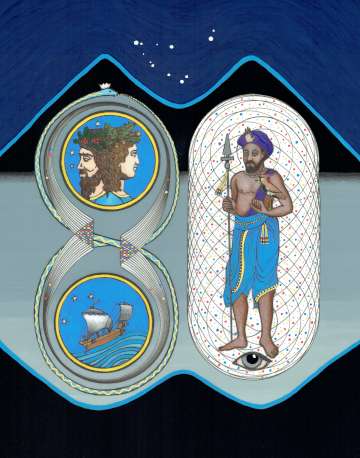
Ascendant decan of Capricorn: A man holding in his right hand a javelin and in his left a lapwing.
Excerpted from Scions of 777:
While Jupiter is not well-placed in Capricorn, up here in the lofty realm of the Twos in Chokmah, the Zodiac itself, it does not seem to hinder him much. It just makes him work a little harder. His drive for expansion is continually challenged by Saturn’s equally strong force of contraction. It is this cycle of expansion and contraction that creates motion and change in the material world. An analogy would be weight (Saturn) lifting (Jupiter). The tension created thus causes positive change – that is, muscle hypertrophy, or growth.
Capricorn is a sign associated with old age, for ruler Saturn is associated with time and has the longest orbit of the classical planets. The swirling designs around the main elements of the image resemble the number eighty. This is a card of progression over time. The course of the average 80 years of a human lifespan has many ups and downs. I associate this decan with embodied incarnation. Austin Coppock’s 36 Faces gives name to the decan as “the headless body”, as seen in the image description from the Sacred Book of Hermes to Asclepius: “He is headless with a man’s body.”
also from Scions of 777:
777 lists the decan image as “A man holding in his right hand a javelin and in his left a lapwing.” Why a javelin, and why a lapwing? Javelins are designed to be thrown and to achieve great distance, perhaps reflecting the striving nature of Capricorn and the distance or linear progression of a life. Lapwing comes from Middle English lapwink, hoopoe, lapwing, from Old English hlēapewince or hlēapan, “to leap” and wincan, “to waver.” To leap, and to waver – an echo of to expand (Jupiter) and to contract (Saturn). Also, it has echoes of the leaping, from peak and valley, of the mountain goat of Capricorn. Hoopoes were sacred in Ancient Egypt, and used as a symbol for gratitude, as they were said to be the only animal that cared for its elderly parents. This is interesting in terms of Capricorn’s association with old age. [end of excerpts]
Hellenistic deity per 36 Airs of the Zodiac fragment: Asclepius, the god of medicine and bodily health, fostered by the Centaur Chiron, killed by Zeus (Jupiter), and placed in the sky as the constellation Ophiuchus the serpent-bearer.
Ptolemaic deity per 777: a mysterious and obscure entity known as Soda, who I speculate upon in the Scions of 777 book. Gundel, in Dekanes and Decansternbilder, mentions a possible connection with the (also obscure) deity Sourut for Pisces II, another Jupiter-ruled decan, through the prefix Sou. In Budge’s Gods of the Egyptians, I found “Sau” as one of the magical names of the Apep serpent, which was at least interesting in terms of the serpent imagery in this card and with Asclepius. And interesting in terms of Crowley associating the Two of Disks with “the serpent of the endless band.”
Expansion and contraction, with overall progress in the material world or in our embodied incarnation.