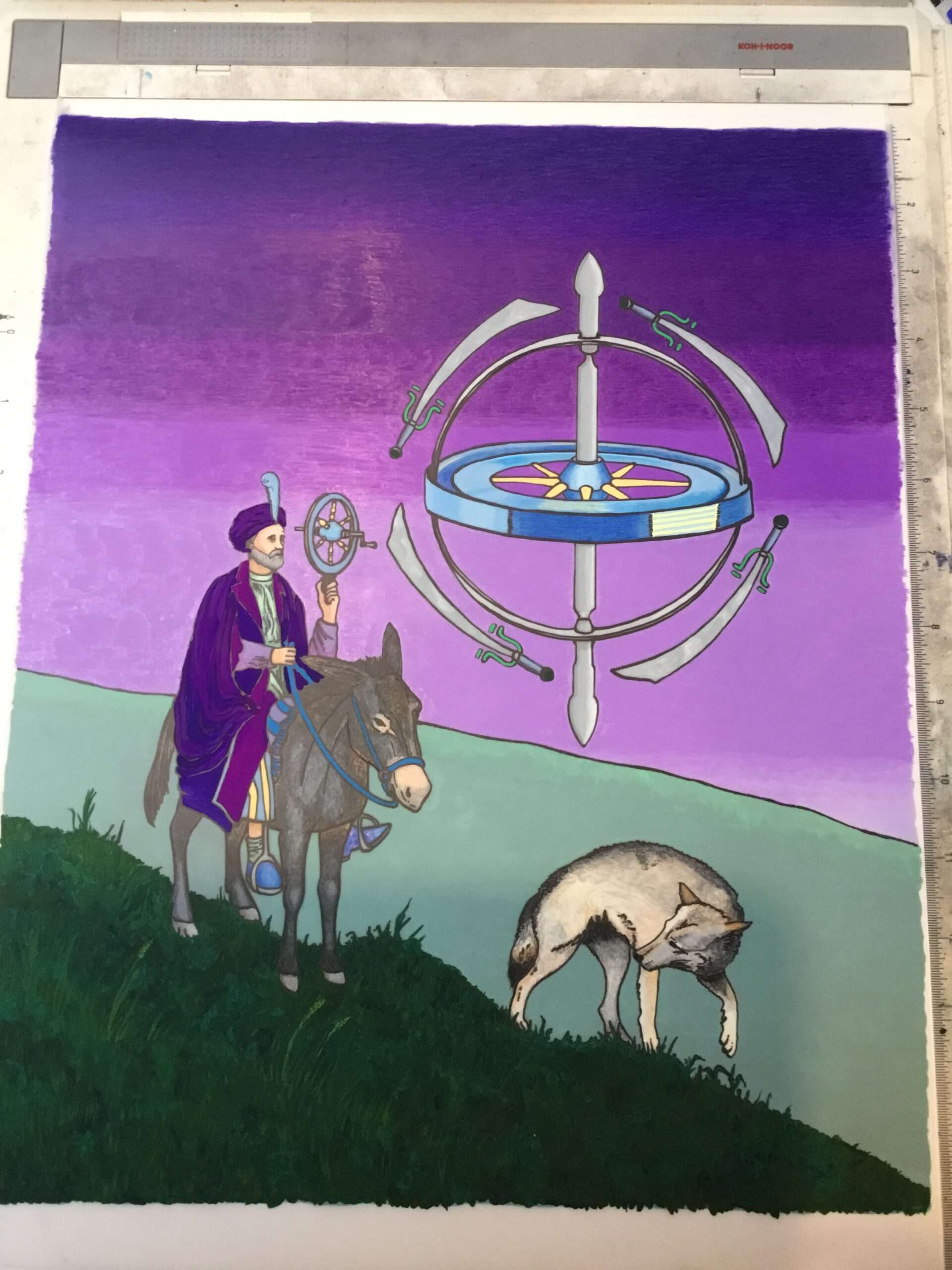
Libra decan 3, Four of Swords, Lord of Truce (Rest from Strife).
Magical image of the decan per 777: Cadent decan of Libra: A man riding on an ass, preceded by a wolf.
Libra is ruled by Venus. The decan, and the Fours, are ruled by Jupiter. Triplicity ruler is Mercury.
Surprising that the card is merely “truce” and not something more beneficial, with the Greater Fortune (Jupiter) and Lesser Fortune (Venus) involved. But in the first card below the Abyss in the Swords suit, we merely get a compromise or rest from strife. The suit of Swords is notoriously troublesome, just like the mind itself the suit represents. The Air element of the Swords suit is inherently turbulent, as the offspring of the two opposing elements Fire and Water.
In the image, there appears to be some sort of truce between the rider, the ass, and the wolf as they plod downhill, presumably after some arduous climb or encounter. The downward slope is a bit of a break from the climb. The four swords revolve around a gyroscope – which is what Austin Coppock calls this decan in his 36 Faces. The wheel symbolism is echoed by the device the man holds, which echoes the wheel carried by Fortuna in some depictions.

Wheels are generally associated with the idea of progress, and of cycles. They symbolize ceaseless change and constant renewal. Buddha set the Wheel of the Law or human fate, the dharma-chakra, into motion. Cycles of fortune can and do rotate, and what is on the top will return to the bottom, and vice-versa.
There is evolution and involution, or spiritual progress and regression. The wheel carried by the figure has a handle to set it into motion, which once started, continues its own momentum and is fateful. Yet at the center of the wheel there is a still-point, where one is motionless. Accessing this stillness is a form of truce. This emptiness is a release from the ceaseless whirl of manifestation, achieved by a return to the center of being.
The ass is often a symbol of obstinate stupidity, idleness, pleasure-seeking, or moral depression. Sometimes though, in medieval emblems, it indicates humility and patience. In alchemical terms it is depicted as a daemon triunus, with three heads representing Mercury, Sulphur, and Salt, the three principles of matter. This reinforces the wheel symbolism, for the three figures on the Wheel card in tarot also correspond to the cycling of the alchemical triad, or the three gunas of Sattva, Rajas, and Tamas.
The wolf can be a guardian and symbol of strength, or a lustful and savage devourer. They are generally considered a chaotic force that needs to be shackled to maintain order. Whether the wolf is wild or domesticated, there is no question that he is perceived as a danger by the donkey; despite any truce things could change.
The Hellenistic deity is Nemesis, who has connections to Fortuna. The Ptolemaic god is the Titan Ophionius, also known as the serpent Ophion, the first ruler of Olympus, before Zeus.
You can feel the garden getting ready to sleep –
Most of the plants have got undressed for bed,
Their petals lie like confetti. Time will sweep
It all away; time doesn’t sleep. Not yet.
yes 🙂